
The best cloud GPU for AI depends on your workload: the H100 or B200 for training large models, the H200 for memory-bound inference, and the RTX 4090 or L40S for cost-efficient small-model inference. Among providers, RunPod, Vast.ai, and Lambda Labs offer the best price-to-performance for most teams in 2026, with specialized neo-clouds costing 40–85% less than hyperscalers for the same GPUs.
This is your starting point for renting AI GPUs. Below you’ll find the right GPU by use case, the top providers, a pricing overview, and a simple framework for choosing — each linking to a deeper guide.
What is the best cloud GPU for AI in 2026?
There’s no single best GPU — only the best one for your workload and budget. This table maps the main options to what they do well:
| GPU | Best for | VRAM | From $/hr |
|---|---|---|---|
| RTX 4090 | Small-model inference, experimentation | 24GB | ~$0.20 |
| A100 80GB | Budget training, fine-tuning | 80GB | ~$0.90 |
| H100 | Training workhorse, FP8 inference | 80GB | ~$1.50 |
| H200 | Memory-bound inference, large context | 141GB | ~$1.45 |
| B200 | High-end training, large-model inference | 192GB | ~$2.25 |
⚠️ Prices are indicative starting rates on neo-clouds and change often — verify live rates before renting.
For the full breakdown of every GPU, how the generations differ, and which card fits your model, see our cloud GPU models guide.
Best cloud GPU by use case
The fastest way to choose is to start from what you’re building.
Training large LLMs
For training 70B+ models, reach for the H100 or B200. The H100’s FP8 support and high bandwidth make it the training workhorse; the B200 adds far more memory and speed for the largest runs. Reliability and interconnect matter as much as price here — a failed multi-day run is expensive. See best GPU for training LLMs.
Inference and serving
Inference is largely memory-bound, so bandwidth and VRAM drive throughput. The H200 (141GB, very high bandwidth) excels at serving large models and long contexts, while the H100 handles FP8 inference efficiently. For smaller models, cheaper cards win on cost-per-token. See best GPU for LLM inference.
Fine-tuning on a budget
Fine-tuning rarely needs top-tier hardware. With LoRA/QLoRA, you can fine-tune even a 70B model on a single A100 or H100 by quantizing the base model. The A100 is usually the value pick. See how to fine-tune an LLM on a cloud GPU and LoRA vs QLoRA.
Image and video generation
For Stable Diffusion and diffusion video, a RTX 4090 delivers excellent performance-per-dollar for most work, stepping up to an A100/H100 only for the heaviest batch jobs. See running Stable Diffusion on a cloud GPU.
Top cloud GPU providers at a glance

Providers fall into three tiers — marketplaces for the lowest cost, specialized AI clouds for balance, and hyperscalers for compliance:
| Provider | Type | Best for |
|---|---|---|
| RunPod | Specialized + marketplace | Best all-round balance |
| Vast.ai | Marketplace (P2P) | Lowest prices, interruptible jobs |
| Lambda Labs | Specialized | ML-focused support, cheap A100 |
| CoreWeave | Specialized (enterprise) | Large-scale & HPC |
| AWS / GCP / Azure | Hyperscaler | Compliance & integration |
For most teams, a specialized neo-cloud gives the same GPUs as a hyperscaler for far less. The full comparison, including hidden costs and billing models, is in our best cloud GPU providers guide.
Cloud GPU pricing overview
Rental rates in 2026 range from about $0.20/hr for a consumer RTX 4090 to $1.50–$3.60/hr for an H100 on neo-clouds — and considerably more on hyperscalers, where an H100 can approach $14/hr. Spot pricing cuts these 50–80% for interruptible workloads.
Two factors swing your bill more than the GPU itself: the provider tier and the billing model. The same H100 job can cost $11 on spot or $72 on a hyperscaler. For the full pricing breakdown and cost-saving tactics, see how much it costs to rent a GPU.
How to choose the right cloud GPU
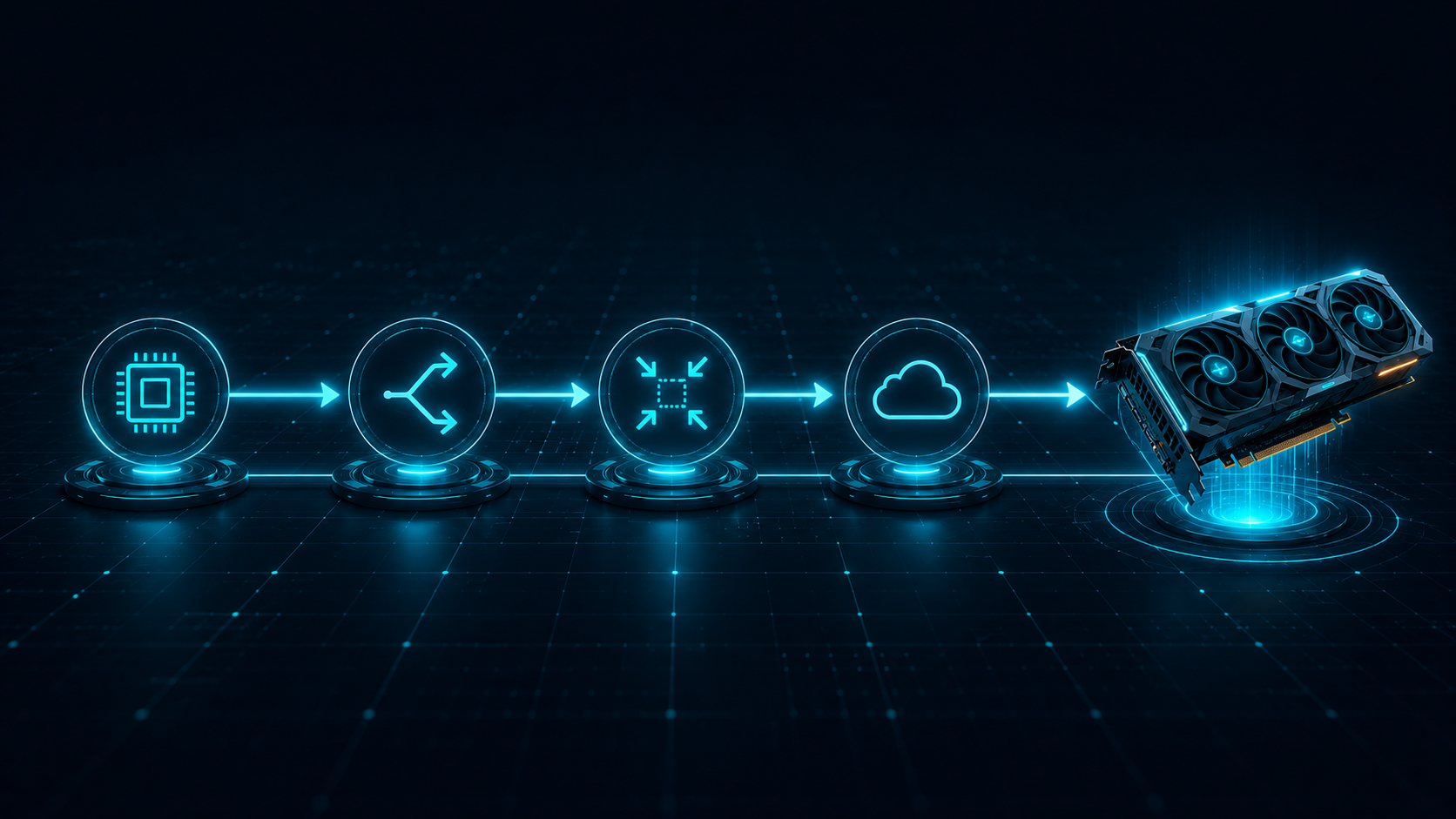
Four steps take you from workload to a running instance:
- Find your model’s VRAM need. Your model must fit in GPU memory — roughly 2GB per 1B parameters at FP16 for inference. Start with the VRAM guide.
- Decide training vs inference. Training favors the H100/B200; memory-bound inference favors the H200.
- Consider quantization. Running in INT8/INT4 can drop you to a smaller, cheaper GPU with minimal quality loss.
- Pick a provider and billing model. Marketplace for cost, specialized for balance; spot with checkpointing for training, on-demand for development.
New to renting? Our how to rent a GPU guide walks through every step, and what is a cloud GPU covers the basics.
Explore by topic
- GPU models — H100, H200, B200, A100, RTX 4090 explained and compared.
- Providers — the best places to rent, compared on price and reliability.
- Pricing — current rates and how to cut your bill.
- Learn — VRAM, fine-tuning, quantization, and how-to guides.
- Use cases — GPUs for startups, researchers, and free options.
The bottom line
Choosing a cloud GPU comes down to matching hardware to your workload, then picking a provider and billing model that fit your budget. Use the H100 or B200 for serious training, the H200 for large-model inference, and the A100 or RTX 4090 for budget and small-scale work — and rent from a specialized neo-cloud to avoid the hyperscaler premium. Start with your model’s VRAM need, quantize where you can, and you’ll land on the right GPU without overpaying.
FAQs
What’s the best GPU for AI training? The H100 is the training workhorse thanks to FP8 support and high bandwidth; the B200 leads for the largest runs. For budget training and fine-tuning, the A100 (80GB) offers the best value. Match the card to your model size and how fully you can use its speed.
What’s the cheapest cloud GPU for AI? Consumer cards like the RTX 4090 are cheapest, from around $0.20/hr, and are ideal for small-model inference and experimentation. On marketplaces like Vast.ai, prices drop further on spot. For data-center cards, spot pricing on neo-clouds is the cheapest route.
Do I need an H100, or is an A100 enough? Often an A100 is enough. The H100 is worth it only when your workload fully uses its 3–5x transformer speedup — large training or FP8 inference. For fine-tuning, smaller models, and budget work, the A100 is the smarter value. See our H100 vs A100 comparison.
What’s the difference between marketplace and hyperscaler GPUs? Marketplaces (Vast.ai) pool spare capacity for the lowest prices with variable reliability; hyperscalers (AWS, GCP, Azure) charge a premium for compliance, integration, and enterprise SLAs. The same GPU is typically 40–85% cheaper on a neo-cloud than on a hyperscaler.