
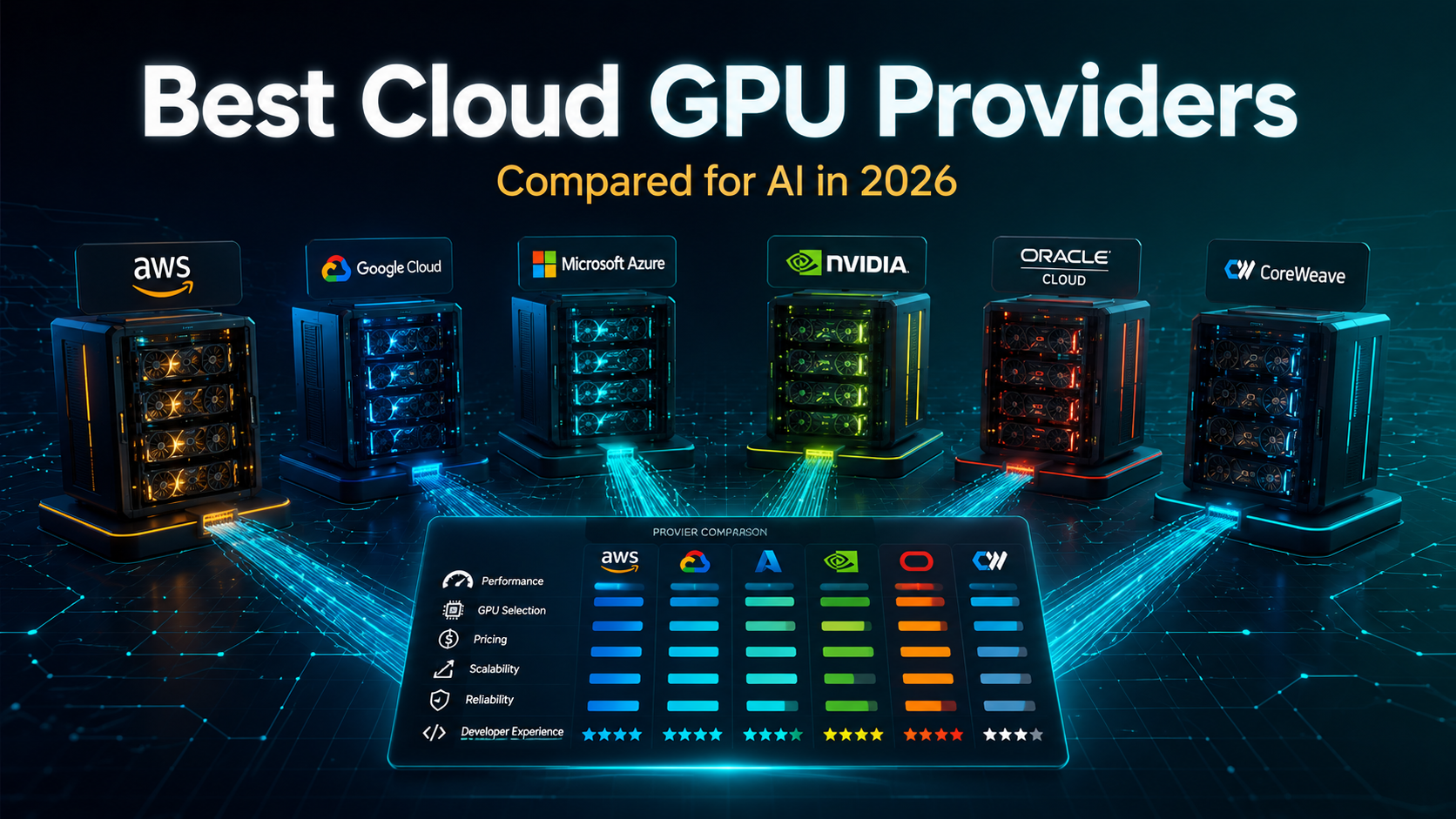
The best cloud GPU providers in 2026 fall into three tiers: marketplaces (Vast.ai, Spheron) for the lowest prices, specialized AI clouds (RunPod, Lambda Labs, CoreWeave) for the best balance of price and reliability, and hyperscalers (AWS, GCP, Azure) for enterprise compliance. For most teams, RunPod offers the best all-round value, Lambda Labs the best support, and Vast.ai the lowest prices. Notably, specialized neo-clouds typically cost 40–85% less than hyperscalers for comparable GPUs.
This guide compares the leading providers on price, billing, GPU availability, and reliability — and shows which one fits your specific workload.
Cloud GPU providers compared (2026)
The table below summarizes the major providers. Prices are indicative starting on-demand rates and shift constantly — treat them as a snapshot, not a quote.
| Provider | Type | Billing | Known for | H100 from | Best for |
|---|---|---|---|---|---|
| Vast.ai | Marketplace (P2P) | Per-second / hr | Lowest prices, variable reliability | ~$3.29 (lower on spot) | Cost-first, interruptible jobs |
| RunPod | Specialized + marketplace | Per-second | Best balance; Secure + Community + Serverless | ~$1.99 | Most teams |
| Lambda Labs | Specialized | On-demand / reserved | ML-focused, premium support, cheapest A100 | ~$2.49 | Reliability & support |
| CoreWeave | Specialized (enterprise) | On-demand + spot | Largest neocloud, HPC, B200/B300 | Enterprise tier | Large-scale & enterprise |
| Spheron | Marketplace / neo-cloud | On-demand + spot | Leading spot prices | ~$1.03 (spot) | Fault-tolerant spot workloads |
| TensorDock | Marketplace | On-demand | Low-cost L40S/consumer | varies | Budget mixed workloads |
| Hyperstack | Specialized | On-demand / reserved | Strong networking for training | varies | Heavy training |
| Nebius | Specialized | On-demand | Full-stack AI cloud | varies | Managed AI platforms |
| Google Colab | Notebook service | Subscription + credits | Beginner-friendly notebooks | n/a | Learning, prototyping |
| AWS / GCP / Azure | Hyperscaler | On-demand / reserved | Compliance & integration | Premium | Enterprise compliance |
⚠️ Prices change weekly. H100 rates have fallen through 2026 as B200 supply grows. Always check live rates before committing.
How we evaluated providers
There’s no single “best” provider — only the one that fits your workload. We weighed four dimensions that matter most in 2026:
Billing granularity. Per-second billing (RunPod, Vast.ai) means you pay only for the seconds you use; some providers still round up to the hour, which adds up on short jobs. Per-second billing is a real cost advantage for iterative work.
Marketplace vs on-demand. Marketplaces (Vast.ai, TensorDock) use competitive supply to drive prices down, but reliability varies host to host. On-demand clouds offer stable, predictable instances at higher rates. The trade-off is price versus dependability.
Hidden costs. Storage, egress (data leaving the cloud), and support-plan fees can rival the GPU cost itself on heavy workloads — especially on hyperscalers. The cheapest headline rate isn’t always the cheapest bill.
Consumer vs data-center GPUs. Consumer cards (RTX 4090, L40S) offer excellent performance-per-dollar for smaller workloads, while data-center GPUs (A100, H100, B200) are built to scale to large models. The right class depends on your model size — see our VRAM guide.
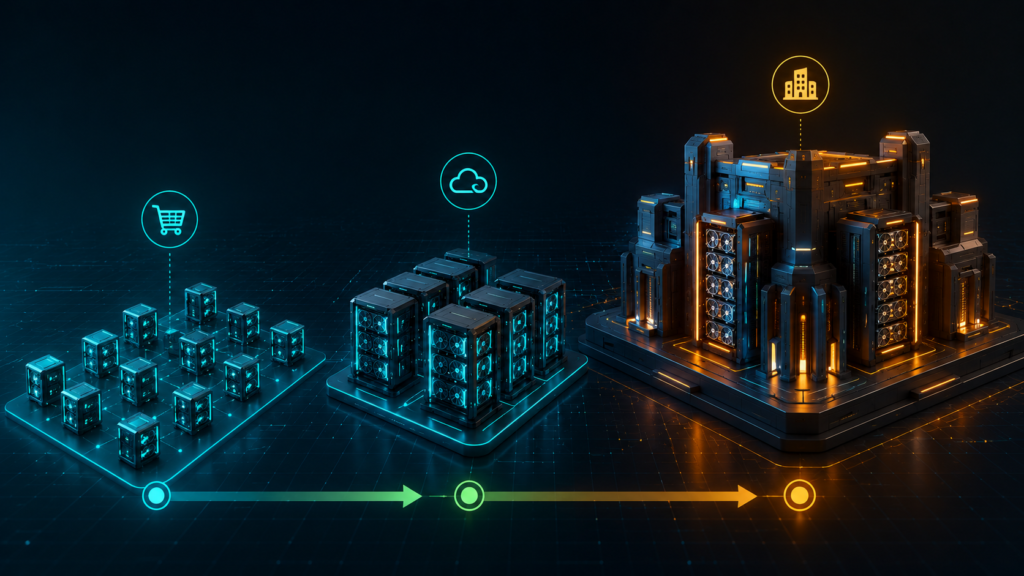
The three tiers of cloud GPU providers
Marketplaces — lowest cost
Marketplaces pool spare capacity from many hosts and let price competition drive rates down. Vast.ai is the prime example: a peer-to-peer marketplace with the lowest prices on consumer GPUs, though reliability varies and it’s generally not recommended for production. Spheron leads on spot pricing for H100, A100, and B200, and TensorDock is another low-cost option. Choose this tier when cost is the priority and your workload tolerates interruption — pair it with frequent checkpointing.
Specialized AI clouds — best balance
Specialized neo-clouds are the sweet spot for most teams: competitive prices, solid reliability, and AI-focused features.
- RunPod offers the best all-round balance, with three modes — Secure Cloud (dedicated, ~99% uptime SLA), Community Cloud (shared, cheaper, no SLA), and Serverless for scale-to-zero inference. Per-second billing and one-click templates make it beginner-friendly.
- Lambda Labs is curated and ML-focused with premium support and strong uptime, and it often has the cheapest A100. Public pricing is on-demand; longer commitments are quote-based.
- CoreWeave is the largest specialist neocloud and an NVIDIA Elite partner, with a deep catalog including B200 and B300. It’s positioned for enterprise and HPC-scale workloads, with pricing closer to the hyperscaler tier.
Hyperscalers — enterprise and compliance
AWS, GCP, and Azure are the most expensive option, but they justify it for organizations needing compliance certifications, IAM/VPC integration, and tight coupling with services like S3 or BigQuery. If your pipeline is already deep in one of these ecosystems, the migration cost to a neo-cloud can outweigh the per-GPU savings — at least short-term. For everyone else, neo-clouds deliver the same GPUs for far less.
Best provider by need
Cheapest
For the lowest absolute prices, use a marketplace — Vast.ai for consumer GPUs, Spheron for spot data-center cards. See our cheapest cloud GPU providers breakdown for where each card hits its floor.
Best for startups
RunPod is the strongest default: per-second billing, no large commitment, easy templates, and a serverless option to control inference costs. It scales from a single GPU to multi-GPU training without switching platforms. See cloud GPU for startups.
Best for serverless inference
For production inference that should scale to zero between requests, RunPod Serverless and similar offerings only bill while requests are processing — ideal for spiky traffic. See best serverless GPU providers.
Best for big training runs
For large multi-week or multi-GPU training, Lambda Labs (support and reliability), CoreWeave (HPC scale, latest GPUs), and Hyperstack (networking) lead. Reliability and interconnect matter more than headline price when a single failed run costs days.
Hidden costs to watch

The headline hourly rate is only part of the bill. Before committing, check:
- Egress fees — moving data out of the cloud, sometimes substantial on hyperscalers. Check transfer costs before uploading large datasets.
- Storage — persistent volumes often bill even while an instance is stopped.
- Minimum commitments — some discounts require time commitments that don’t suit bursty work.
- Support plans — enterprise support tiers add cost on some providers.
- Stop vs terminate — “stopping” may keep paid storage alive; know your provider’s rules.
For the full pricing picture, see how much it costs to rent a GPU.
How to choose
- Match the GPU class to your model — consumer for small, data-center for large. Use the VRAM guide.
- Pick a tier by priority — marketplace for cost, specialized for balance, hyperscaler for compliance.
- Choose a billing model — spot with checkpointing for training, on-demand for development, reserved for steady production.
- Check hidden costs — egress and storage before you commit.
Then launch: our how to rent a GPU guide walks through the steps.
The bottom line
For most AI teams in 2026, a specialized neo-cloud — RunPod for balance, Lambda Labs for support, CoreWeave for enterprise scale — delivers the same GPUs as a hyperscaler for 40–85% less. Reach for a marketplace like Vast.ai when cost is paramount and the work tolerates interruption, and a hyperscaler only when compliance or deep integration demands it. Match the tier to your priority, watch the hidden costs, and the right provider follows from your workload.
FAQs
Which cloud GPU provider is cheapest? Marketplaces are cheapest. Vast.ai typically has the lowest prices on consumer GPUs, and Spheron leads on spot pricing for data-center cards like the H100 and B200. The trade-off is variable reliability, so pair them with checkpointing.
Is a marketplace GPU safe to use? For fault-tolerant and interruptible workloads, yes — with frequent checkpointing. Marketplaces like Vast.ai have variable reliability and aren’t recommended for latency-sensitive production. For production uptime, choose a specialized cloud’s dedicated tier.
Which provider is best for fine-tuning? RunPod and Lambda Labs are both strong: RunPod for per-second billing and flexibility, Lambda for the cheapest A100 and ML-focused support. For budget fine-tuning with QLoRA, a single rented A100 on either is cost-effective.
Do hyperscalers charge more for the same GPU? Yes — typically much more. For comparable GPUs, specialized neo-clouds usually cost 40–85% less than AWS, GCP, or Azure. Hyperscalers justify the premium with compliance, integration, and enterprise SLAs, not raw GPU value.