
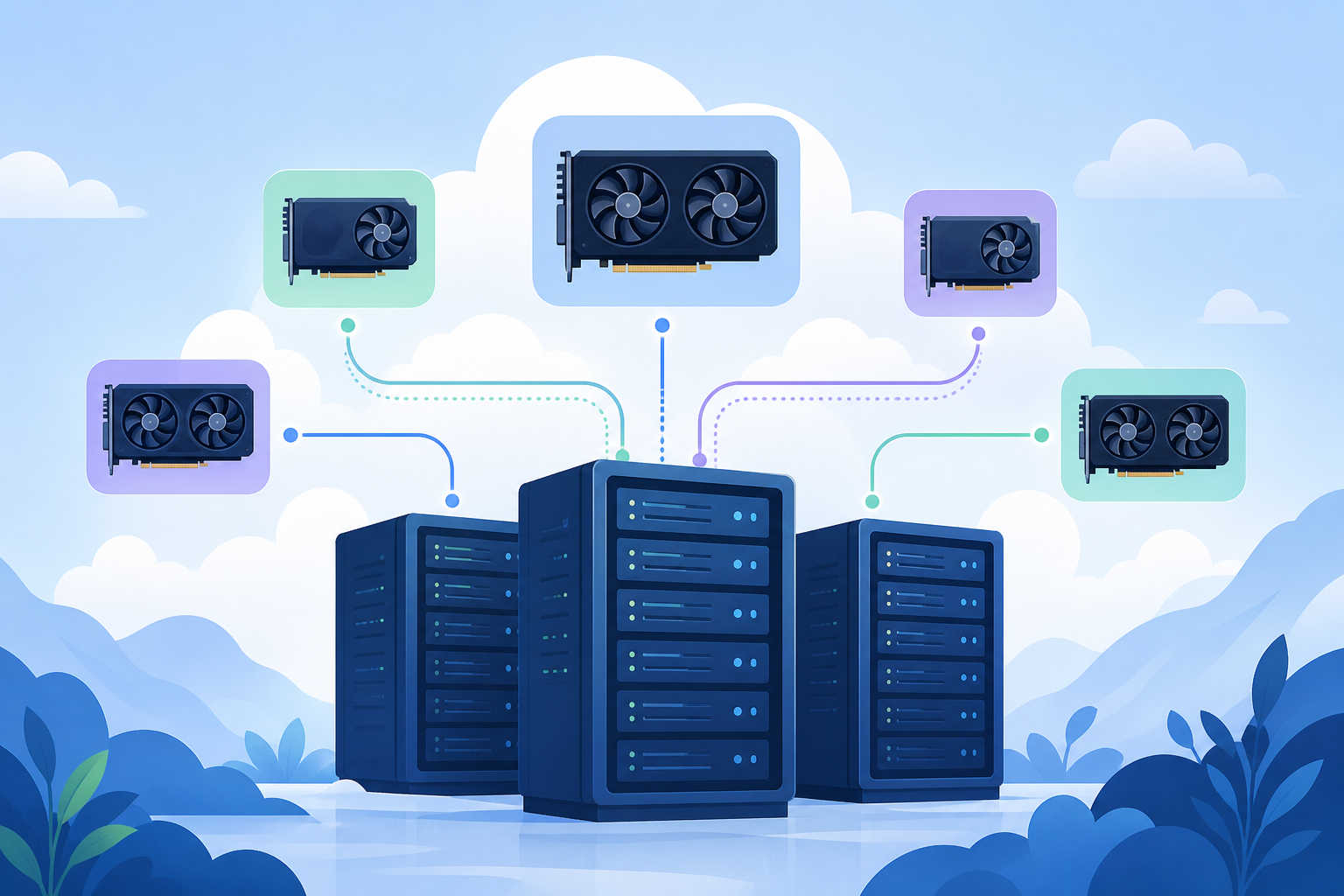

Cloud GPU for startups lets founders run AI training and inference workloads rapidly without upfront hardware investments—ideal for experimentation, scaling, and optimizing cost-efficiency.
What does “cloud GPU for startups” mean?
Cloud GPU for startups refers to renting GPU compute capacity from cloud platforms to train, fine-tune, or serve AI models—on-demand, scalable, and without owning physical hardware.
Why should startups use cloud GPUs?
- Immediate access: Spin up GPU instances within minutes for rapid prototyping and validation.
- No capital expenditure: Avoid buying expensive GPUs; pay hourly or per-token instead.
- Scalable with demand: Automatically scale for spikes (e.g., inference traffic) or shut down to save cost.
- Access to latest silicon: Tap into H100, A100, or L40S without procurement delays.
Which cloud‑GPU providers align with startup needs?
Sources consistently highlight several platforms built for startups:
- RunPod: Self‑serve, pay‑as‑you‑go, no commitments; spot pricing makes experimentation cheap.([sourcegpu.com](https://sourcegpu.com/blog/10-best-gpu-cloud-platforms-for-startups))
- Vast.ai: Ultra‑low costs via a marketplace of aggregated GPUs—best for non‑ production, fault‑tolerant tasks.([sourcegpu.com](https://sourcegpu.com/blog/10-best-gpu-cloud-platforms-for-startups))
- Lambda Labs: Pre‑configured clusters, academic discounts, simple billing—great for early production and low DevOps overhead.([sourcegpu.com](https://sourcegpu.com/blog/10-best-gpu-cloud-platforms-for-startups))
- Modal: Serverless GPU with fast cold start and autoscaling—fits unpredictable workloads with minimal idle cost.([sourcegpu.com](https://sourcegpu.com/blog/10-best-gpu-cloud-platforms-for-startups))
- CoreWeave: Scalable on‑demand tier, accessible without enterprise procurement—useful post‑initial funding.([sourcegpu.com](https://sourcegpu.com/blog/10-best-gpu-cloud-platforms-for-startups))
- Packet.ai: Supports diverse NVIDIA silicon, hour billing, no minimums—transition from dev to prod seamlessly.([packet.ai](https://packet.ai/use-cases))
How to choose: Provider comparison
| Provider | Best For | Cost/Billing | Ideal Stage |
|---|---|---|---|
| RunPod | Cheap experimentation | Spot $0.89–1.49/hr for H100; on‑demand ~$2.99/hr | Pre‑seed / dev |
| Vast.ai | Low cost non‑prod runs | Variable marketplace pricing | Experimentation |
| Lambda Labs | Reliable inference, simple setup | ~$3.99/hr H100; free signup credits | Seed to Series A |
| Modal | Autoscaled, serverless inference | Usage‑based; no idle cost | Unpredictable workloads |
| CoreWeave | Heavy training, scaling fast | Reserved & on‑demand tiers | Series A+ scaling |
| Packet.ai | Full stack dev-to-prod | Hourly billing; various GPUs | All stages |
Note: Dollar figures are indicative; verify current pricing during procurement. (verify_before_publish).
What startup use case paths work best?
- Early experimentation (pre‑seed): Use no-min commitment platforms like RunPod or Vast.ai to test iteratively. Use spot pricing where tolerable.
- First inference/validation (seed): Shift to Lambda Labs or Modal for smoother UX, Jupyter support, autoscaling. Great for delivering MVP API endpoints quickly.
- Scaling (Series A+): Transition to CoreWeave or Packet.ai to support sustained training and serving workloads with better unit economics.
- Cost control through credits: Join programs like NVIDIA Inception, Google for Startups, Lambda/CoreWeave startup credits to reduce spend.([startupflowai.com](https://startupflowai.com/guides/gpu-credits-for-ai-startups))
- Hybrid and ownership planning: If utilization is high and sustained, start planning dedicated hardware via colocation to reduce per-GPU‑hour cost within ~12–18 months.([arccompute.io](https://www.arccompute.io/industries/ai-startups))
Concrete example: Sequence of choice
Team at pre‑seed wants to launch an image generation MVP:
- Start with RunPod spot H100 ($0.9–1.5/hr) for fine‑tuning lightweight models; compare Vast.ai.
- Gain traction—switch to Lambda Labs instances for inference endpoints. Use signup credits (~$500) to offset initial cost.([gpuadvisor.com](https://gpuadvisor.com/best-gpu-cloud-for-startups))
- At Series A, migrate to CoreWeave reserved GPUs or Packet.ai clusters for sustained usage, improving cost predictability and performance.
- Parallel: Apply to NVIDIA Inception, RunPod, Lambda startup credits to secure free compute.([startupflowai.com](https://startupflowai.com/guides/gpu-credits-for-ai-startups))
- Monitor spend; if GPU utilization exceeds 60–70%, analyze ROI on buying own systems in colocation.([arccompute.io](https://www.arccompute.io/industries/ai-startups))
How can startup GPU credits cut burn?
Compute often consumes 40–60% of a startup’s tech budget in early years.([thundercompute.com](https://www.thundercompute.com/blog/leading-gpu-cloud-solutions-startup-companies)) Combining credits from programs across vendors can extend runway by months. Examples include up to $200k in Google Cloud credits, $150k from Nebius, and perks from Lambda, CoreWeave, RunPod, Together AI, etc.([startupflowai.com](https://startupflowai.com/guides/gpu-credits-for-ai-startups))
What risks or edge cases to watch?
- Spot instability: Spot pricing may interrupt workloads; ensure checkpoints or prefer on-demand for critical inference.
- Vendor lock-in: If your provider increases prices suddenly, ensure you can switch or have hybrid fallback.([reddit.com](https://www.reddit.com/r/AiKilledMyStartUp/comments/1tbojrz/your_startup_runs_on_gpus_you_do_not_control_and/))
- Budget misestimation: Track per-hour and token billing closely, especially with autoscaling platforms.
- Compliance/regional needs: For EU data residency or contracts (e.g., genomics), use providers that support those constraints like packet.ai or Hyperstack.([packet.ai](https://packet.ai/use-cases))
Abstract GPU clouds for section “why use cloud GPUs”

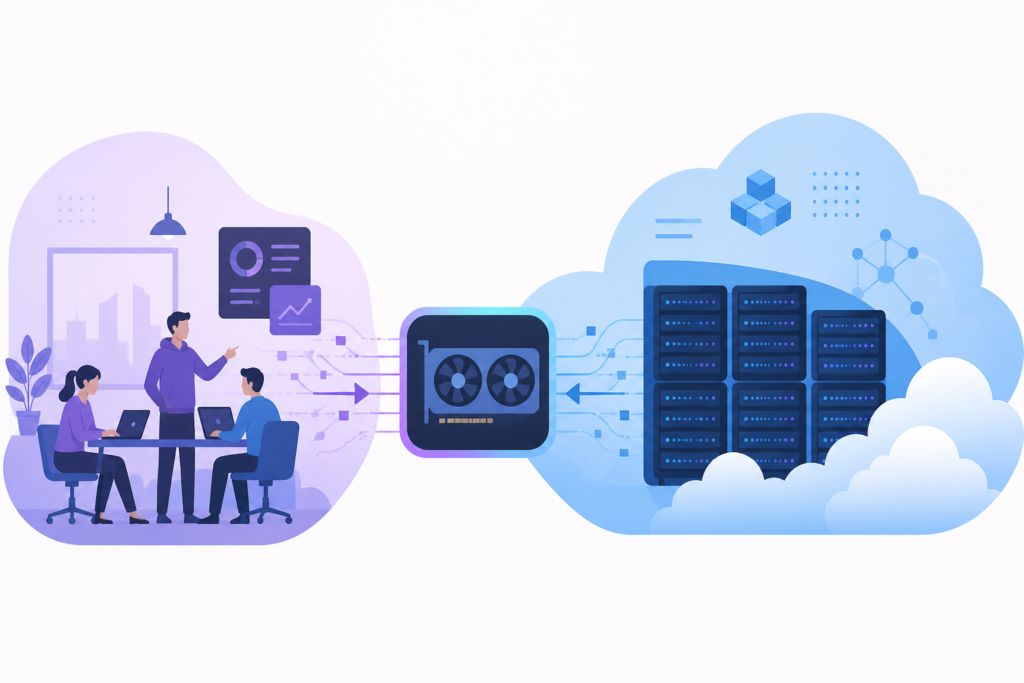
Startup journey from experiment to scaling with cloud GPU providers
About the Author
cloudgpuhub.com – Nhon Dang is a cloud infrastructure and operations professional with over 10 years of hands-on experience in cloud services, infrastructure, and business operations, including cloud GPU infrastructure. He writes from practical experience to guide teams in cost-efficient and scalable cloud decisions.
Frequently Asked Questions
What is the cheapest option to try cloud GPUs as a startup?
RunPod spot instances (e.g., H100 at $0.89–1.49/hr) are among the cheapest for experimentation, while Vast.ai offers variable low-cost marketplace GPU access—best used for non‑critical or fault‑tolerant workloads.
When should a startup move from experimentation to production‑ready GPU infrastructure?
Once your workload requires repeatable inference or fine‑tuning at scale, transition to platforms like Lambda Labs or Modal that offer stable pricing, user-friendly environments, and autoscaling to support production use.
How can startups reduce GPU compute costs effectively?
Stack startup programs and credits—like those from NVIDIA Inception, Google for Startups, Lambda, CoreWeave, RunPod, Together AI, etc.—which collectively can provide tens or hundreds of thousands of dollars in GPU credits, extending runway significantly.
At what point should a startup consider buying its own GPUs instead of renting?
If sustained utilization exceeds around 60–70% and compute budget becomes large, running cost models may justify buying hardware colocated in data centers, often paying back within 12–18 months for high-demand workloads.
What are common risks when relying solely on cloud GPU vendors?
Risks include spot instance interruptions, sudden price increases, vendor lock‑in, unexpected autoscaling cost spikes, and compliance limitations. Guard against this with checkpoints, multi‑vendor flexibility, and monitoring.