
Last updated: September 27, 2026
Answer‑first: The best GPU for LLM inference depends on matching VRAM and memory bandwidth to your model size and throughput needs—datacenter GPUs like NVIDIA H100, B200, or AMD MI300X excel at large models, while consumer GPUs like RTX 5090 or used RTX 3090 offer strong performance-per-dollar for local inference.
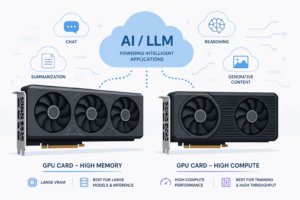
Why bandwidth & VRAM matter more than raw compute for inference?
LLM inference is memory‑bandwidth‑bound: during autoregressive decoding, GPUs spend most of their time streaming model weights and KV cache from VRAM—not doing FLOPs. That means high TFLOPS doesn’t translate directly into token throughput. Instead, memory bandwidth and sufficient VRAM to hold both the model and KV cache drive real performance. For example, the H200 doubles throughput over H100 purely via more VRAM and bandwidth, with identical compute specs. ([dreaming.press](https://www.dreaming.press/posts/2026-06-22-gpu-for-llm-inference-h100-vs-h200-vs-a100-vs-l40s.html))
Which datacenter GPUs perform best for LLM inference?
NVIDIA H100
The H100 remains ubiquitous for LLM inference, with deep software ecosystem support (vLLM, TensorRT‑LLM) that often lets it outperform newer chips in production—even when raw specs lag. Its 80 GB HBM capacity handles ~70B models with INT8 quantization, though FP16 models may require sharding and add latency. ([gpuadvisor.com](https://gpuadvisor.com/blog/best-gpu-for-llm-inference-2026))
AMD MI300X
MI300X offers 192 GB HBM3e and ~5.3 TB/s bandwidth, letting you run 70B FP16 models on a single GPU with ample KV cache for long context. Throughput gains vs H100 range from ~12% to ~23% depending on batch sizes. Ideal for teams upgrading from H100. ([gpuadvisor.com](https://gpuadvisor.com/blog/best-gpu-for-llm-inference-2026))
NVIDIA B200
B200 combines 192 GB HBM3e with ~8 TB/s bandwidth and novel FP4 support—making it capable of running even 405B‑parameter models at Q4 precision. Suited for forward‑looking deployments needing wide model size flexibility. ([gpuadvisor.com](https://gpuadvisor.com/blog/best-gpu-for-llm-inference-2026))
What about top consumer GPUs for local inference?
For on‑prem or local inference, VRAM capacity and bandwidth still make or break performance.
NVIDIA RTX 5090 (32GB GDDR7)
The consumer performance leader of 2026, the RTX 5090 offers 32 GB GDDR7 and ~1.8 TB/s bandwidth. It handles 70B models (Q4) with context headroom and delivers ~10k+ tokens/sec prompt throughput on smaller models. However, street prices (~$4,300) far exceed the $2k MSRP. ([knowledgelib.io](https://knowledgelib.io/computing/components/gpus-for-llm-inference/2026))
NVIDIA RTX 3090 (used, 24GB GDDR6X)
Even years later, the used RTX 3090 (~$800–1,000) remains the best VRAM‑per‑dollar option—24 GB VRAM and solid bandwidth let it run 32B models at Q4 comfortably. For budget-conscious inference, it’s still the go-to card. ([knowledgelib.io](https://knowledgelib.io/computing/components/gpus-for-llm-inference/2026))
Other consumer picks
Cards like RTX 5060 Ti 16 GB (~$560) are entry-level options for 7–20B models. AMD RX 7900 XTX (24 GB, ~$1.4k) is now viable thanks to ROCm 7.2 compatibility with major inference frameworks—but still pricier per GB than used RTX 3090s. ([knowledgelib.io](https://knowledgelib.io/computing/components/gpus-for-llm-inference/2026))
How to pick: A decision framework
- Estimate model size and quantization (FP16 ~2 GB/B, Q4 ~0.5 GB/B) to determine VRAM requirements.
- Select GPU class: datacenter (H100/B200/MI300X) if scaling large models; consumer (RTX 5090, RTX 3090) for local inference.
- Match memory bandwidth: higher bandwidth translates to better throughput, especially at low batch sizes.
- Factor software support—H100 has mature ecosystem; AMD is catching up.
- Check cost per token or throughput in your stack—stats from Bitpute or consumer benchmarks offer real guidance. ([bitpute.com](https://bitpute.com/benchmarks/))
Summary comparison table
| GPU | Memory | Bandwidth | Best For | Key Trade-Off |
|---|---|---|---|---|
| NVIDIA H100 | 80 GB HBM | ~3.35 TB/s | 70B models, stable infra | Memory tight, INT8 only |
| AMD MI300X | 192 GB HBM3e | 5.3 TB/s | Large FP16 models, long context | Software maturity |
| NVIDIA B200 | 192 GB HBM3e | ~8 TB/s | Up to 405B models with FP4 | New, limited ecosystem |
| RTX 5090 | 32 GB GDDR7 | ~1.8 TB/s | Local 70B Q4 inference | High cost |
| RTX 3090 (used) | 24 GB GDDR6X | ~936 GB/s | Budget 32B Q4 inference | 24 GB limit |
Frequently Asked Questions
See below.