
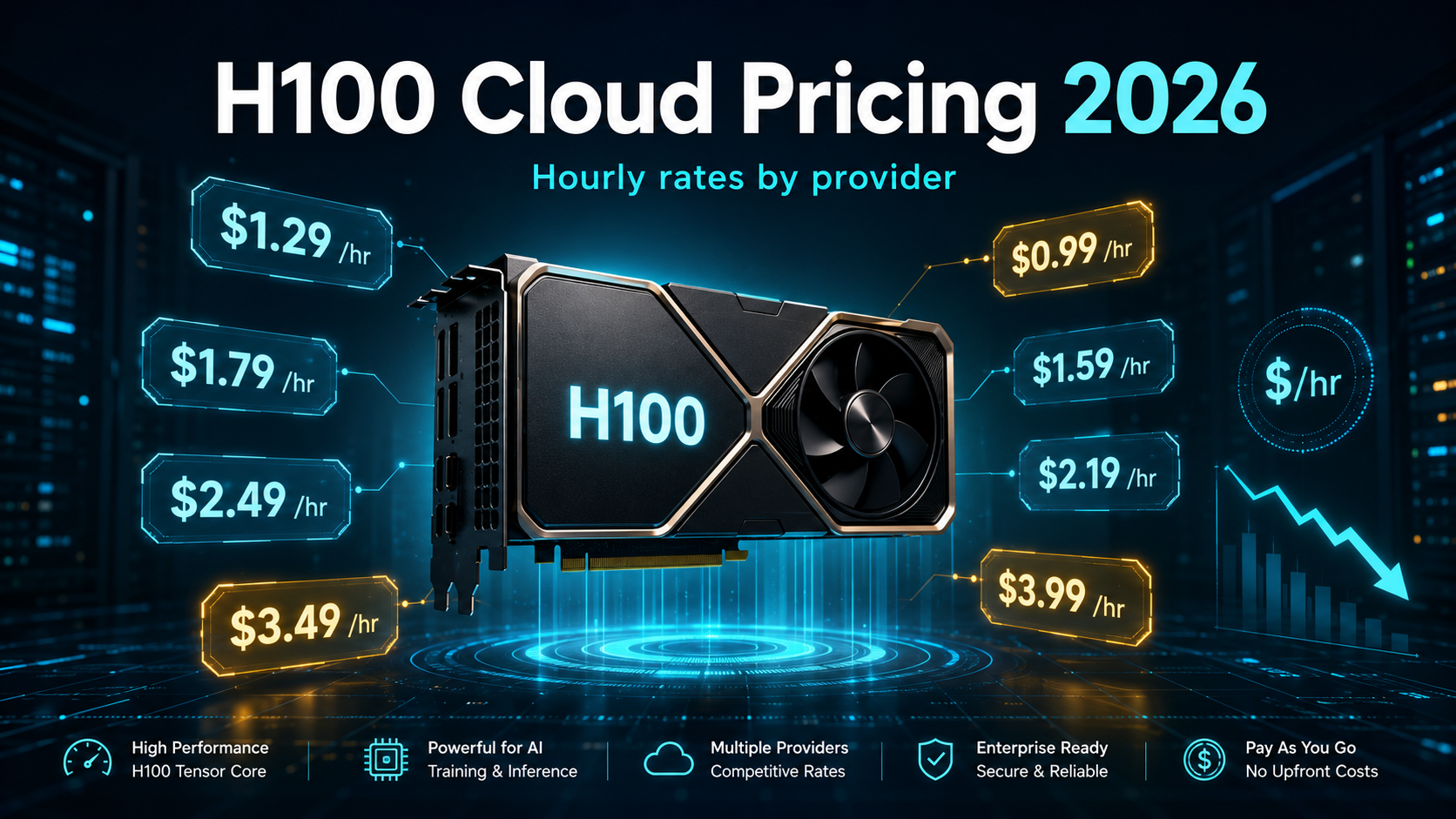
NVIDIA H100 cloud rental costs roughly $1.99/hr on RunPod, $2.49/hr on Lambda Labs, and about $1.87/hr on Vast.ai, dropping to ~$1.03/hr on spot (Spheron). Hyperscalers charge far more — up to ~$12/hr on Azure. The most striking fact about H100 pricing in 2026: the same GPU can cost nearly 14x more on one provider than another.
This guide compares current H100 hourly rates across every major provider, explains why they vary so wildly, and shows how to get the lowest price.
H100 pricing by provider

Rates below are single-GPU H100 hourly prices as of mid-2026. Note that SXM and PCIe variants differ, and spot prices fluctuate constantly.
| Provider | Type | On-demand ($/hr) | Spot ($/hr) |
|---|---|---|---|
| Spheron | Neo-cloud / marketplace | ~$2.50 | ~$1.03 |
| RunPod | Specialized | $1.99 (Community) / $2.89 (Secure) | ~$1.19 |
| Vast.ai | Marketplace (P2P) | ~$1.49–$1.87 | lower, varies |
| Cudo Compute | Neo-cloud | ~$1.80 | — |
| TensorDock | Marketplace | ~$1.99–$2.25 | — |
| Lambda Labs | Specialized | $2.49–$2.99 (SXM), $3.29 (PCIe) | — |
| CoreWeave | Enterprise neo-cloud | ~$6.16 | + spot |
| AWS (p5) | Hyperscaler | ~$6.88 | ~$2.00–$2.50 |
| GCP (a3) | Hyperscaler | ~$3.00–$11.06 | — |
| Azure | Hyperscaler | ~$12.29 | — |
⚠️ H100 spot prices can change multiple times per hour. Every figure here is a snapshot — verify live rates before renting.
The takeaway is clear: neo-clouds and marketplaces cluster around $1.50–$3.00/hr, while hyperscalers run 2–5x higher for the identical GPU. If you don’t need enterprise compliance, paying hyperscaler rates for an H100 is usually overpaying.
Why do H100 prices vary so much?
A community thread tracking H100 rates across 25 providers found a 13.8x price difference for the same GPU — from $0.80/hr at the cheapest to over $11/hr at the most expensive. That gap comes down to four factors:
Provider tier. Marketplaces pool spare capacity and compete on price; specialized neo-clouds add reliability at a modest premium; hyperscalers charge most for compliance and integration.
Billing model. Spot/interruptible rates undercut on-demand by 50–80%. The Spheron spot floor of ~$1.03/hr versus its $2.50/hr on-demand shows the size of that discount.
GPU variant. The H100 SXM (higher bandwidth, NVLink) and H100 PCIe are priced differently — and how a provider publishes the price matters too. Hyperscalers often quote a full VM (compute, memory, storage bundled), which inflates the headline number versus a “naked GPU” rate.
Region and availability. Capacity-constrained regions cost more, and prices shift as supply changes.
How H100 prices have fallen
H100 rental has become dramatically cheaper since its 2023 launch. Early adopters paid rates like $7–11/hr on hyperscalers; by 2026 specialist clouds routinely offer the same GPU under $3/hr. The arrival of the B200 (Blackwell) is pushing H100 prices down further as data centers upgrade and demand shifts to newer silicon. If you’re renting H100s, this trend works in your favor — but it also means any quoted price ages quickly.
H100 vs alternatives on price
Two comparisons are worth making before committing to an H100:
H100 vs A100. The A100 rents from roughly $1.00–$2.00/hr — cheaper, and often enough for budget training and fine-tuning. The H100 is worth its premium only when your workload uses its 3–5x transformer speedup. See our full H100 vs A100 comparison.
H100 vs B200. The newer B200 starts around $2.12/hr on spot and averages ~$5/hr on-demand — a premium over the H100 for far more memory and bandwidth. For workloads that fit the H100, it remains the better value in 2026.
How to get the cheapest H100
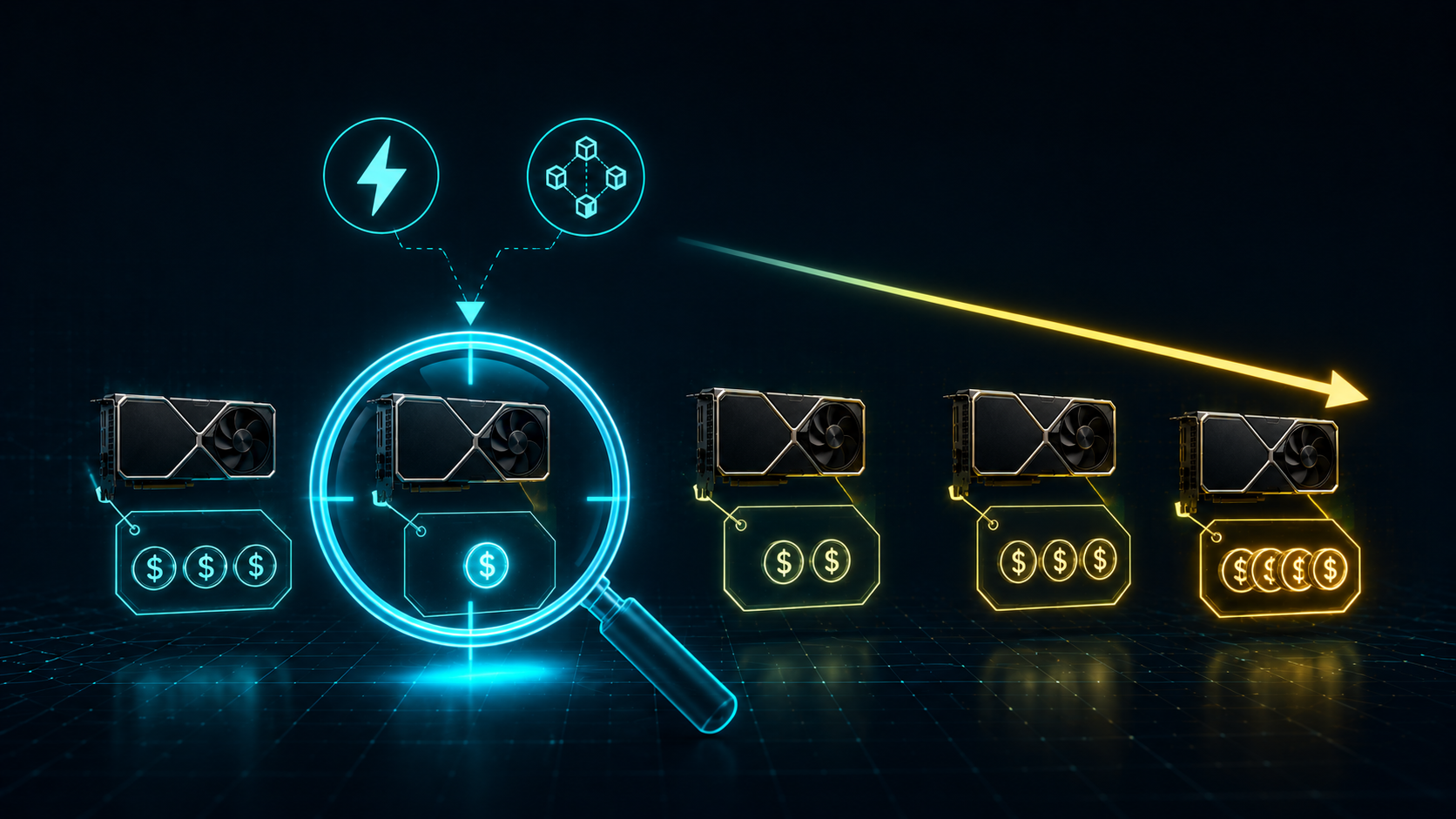
Five tactics get you the lowest H100 rate:
- Use spot pricing. The single biggest lever — spot cuts 50–80% off on-demand. Pair it with frequent checkpointing so interruptions cost minutes.
- Choose a marketplace or neo-cloud. Spheron, Vast.ai, and RunPod consistently undercut hyperscalers. See our cheapest cloud GPU providers breakdown.
- Pick PCIe over SXM if you don’t need the extra bandwidth or multi-GPU NVLink.
- Watch for bundled VM pricing. A hyperscaler’s headline rate may include compute and storage you’re paying for regardless.
- Match the region to availability, and avoid egress fees by keeping data in-region.
For the full cost picture across all GPUs, see how much it costs to rent a GPU.
Is the H100 worth it?
At $1.50–$3.00/hr on a neo-cloud, the H100 is excellent value for large-model training and FP8 inference — workloads that fully use its speed. For smaller models, fine-tuning, and budget experimentation, a cheaper A100 or RTX 4090 often delivers better cost-per-result. Size the GPU to the workload, and rent from a neo-cloud rather than a hyperscaler, and the H100 is one of the best-value data-center GPUs available. For full specs, see our H100 guide.
The bottom line
H100 cloud pricing in 2026 spans from ~$1.03/hr on spot to over $12/hr on hyperscalers — a nearly 14x spread for the same silicon. The provider tier and billing model, not the GPU itself, decide your bill. Use spot pricing on a neo-cloud or marketplace, watch for bundled VM rates, and verify live prices at deployment, since the H100 market keeps getting cheaper.
FAQs
How much does an H100 cost per hour?
On specialized neo-clouds, roughly $1.99/hr (RunPod) to $2.99/hr (Lambda Labs), and about $1.87/hr on the Vast.ai marketplace. Spot pricing drops as low as ~$1.03/hr. Hyperscalers charge 2–5x more, up to ~$12/hr on Azure.
What’s the cheapest H100?
Spot pricing on marketplaces and neo-clouds is cheapest — around $1.03/hr on Spheron spot as of mid-2026, with RunPod spot occasionally near $1.19/hr. The trade-off is interruptibility, so use checkpointing.
Why is the H100 cheaper now than in 2023?
Supply has expanded and demand is shifting to newer GPUs like the B200. Early H100 rates on hyperscalers reached $7–11/hr; by 2026 specialist clouds offer the same GPU under $3/hr, and prices continue to fall as data centers upgrade.
Is an H100 more expensive than a B200?
No — the B200 is newer and pricier, starting around $2.12/hr on spot and averaging ~$5/hr on-demand, versus ~$1.03–$3/hr for an H100. The H100 remains the better value for workloads that don’t need the B200’s extra memory.