
Renting a cloud GPU costs roughly $0.20–$0.50/hr for a consumer RTX 4090, $1.50–$3.60/hr for an NVIDIA H100 on specialized AI clouds (up to ~$14/hr on hyperscalers), and $2.25–$6/hr for a B200. Spot pricing cuts these 50–80% for interruptible workloads. Your actual cost depends on the GPU, the provider tier, and whether you use on-demand or spot.
This guide breaks down current per-hour and per-month prices by GPU, explains what drives the cost, and shows how to cut your bill without changing hardware.
Cloud GPU rental prices in 2026
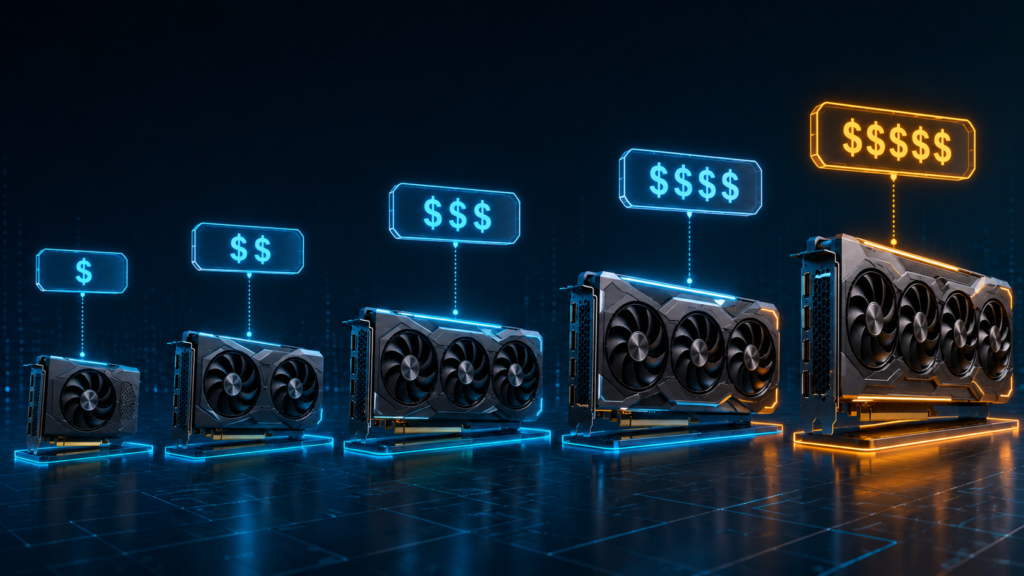
The table below shows typical rates on specialized AI clouds and marketplaces (RunPod, Vast.ai, Lambda Labs). Hyperscalers (AWS, GCP, Azure) charge 2–4x more for the same silicon.
| GPU | VRAM | On-demand ($/hr) | Spot (from) | ~Monthly (720h) |
|---|---|---|---|---|
| RTX 4090 | 24GB | $0.20–$0.69 | ~$0.15 | ~$150–$500 |
| A100 80GB | 80GB | $0.90–$1.80 | ~$0.66 | ~$650–$1,300 |
| H100 80GB | 80GB | $1.50–$3.60 | ~$1.40 | ~$1,100–$2,600 |
| H200 | 141GB | $1.45–$3.99 | varies | ~$1,050–$2,900 |
| B200 | 192GB | $2.25–$6.00 | varies | ~$1,600–$4,300 |
⚠️ Prices are volatile. H100 rates have fallen sharply through 2026 as B200 supply grows — always check live rates before committing.
Two things stand out. First, the spread within a single GPU is huge — an H100 can cost $1.50 or $14 per hour depending entirely on where you rent it. Second, monthly costs add up fast: running an H100 continuously for a month lands near $2,000+ on a neo-cloud, which is why matching the GPU to the workload matters so much.
What affects GPU rental cost?
Four factors explain almost all the price variation you’ll see:
Provider tier. Marketplaces (Vast.ai) are cheapest because they pool spare capacity. Specialized AI clouds (RunPod, Lambda) sit in the middle with better reliability. Hyperscalers are most expensive but offer enterprise compliance and integration. The same H100 can differ 3–4x across these tiers.
Billing model. On-demand is the headline rate. Spot/interruptible instances run 50–80% cheaper but can be reclaimed at any time. Reserved or committed contracts lower the rate further in exchange for a time commitment.
Region. Capacity-constrained regions cost more; rates vary meaningfully by data-center location.
Hidden costs. This is where bills surprise people — egress fees (data leaving the cloud), storage for datasets and checkpoints, idle instances you forgot to stop, and minimum-commitment fees. On marketplaces these are often near zero; on hyperscalers they can rival the GPU cost itself.
On-demand vs spot vs reserved
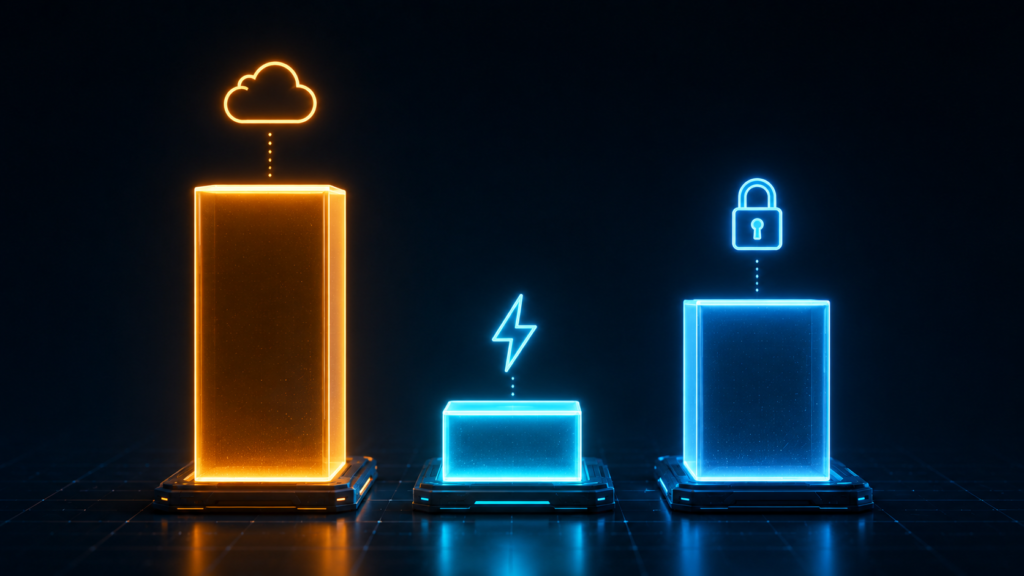
Choosing the right billing model is the biggest lever on cost after picking the GPU.
On-demand — pay by the second/hour, start and stop freely, no interruption risk. Best for development, short jobs, and latency-sensitive inference.
Spot / interruptible — 50–80% cheaper, but the provider can reclaim the instance with little warning. Ideal for fault-tolerant training that checkpoints regularly, batch jobs, and experimentation. The savings are large enough that most training should use spot with checkpointing.
Reserved / committed — lowest rate for steady, predictable workloads, in exchange for a 1-month-plus commitment. Best for production inference running 24/7.
We cover the trade-offs and when each pays off in our spot vs on-demand GPU guide.
Worked example: what a real job costs
Headline rates are abstract. Here’s what an actual workload runs:
Suppose you fine-tune a model with QLoRA, a job that takes about 8 hours on a single H100:
| Approach | Rate | Hours | Total |
|---|---|---|---|
| H100 on-demand (neo-cloud) | $2.50/hr | 8 | $20.00 |
| H100 spot | $1.40/hr | 8 | $11.20 |
| H100 on hyperscaler | $9.00/hr | 8 | $72.00 |
The same job ranges from ~$11 to $72 depending only on provider and billing model. That 6x spread — not the GPU choice — is usually where teams overspend.
Cost by GPU
A quick orientation on where each GPU lands; see the linked pages for live pricing.

H100 — the training and high-throughput-inference workhorse. $1.50–$3.60/hr on neo-clouds; far more on hyperscalers. See H100 pricing.
B200 — the latest Blackwell card, $2.25–$6/hr, for high-end training and large-model inference. See B200 pricing.
A100 — still the value pick for budget training and fine-tuning, from ~$0.90/hr.
RTX 4090 — cheapest path to GPU compute, from ~$0.20/hr, ideal for small-model inference and experimentation.
How to reduce cloud GPU costs
Five levers cut your bill without sacrificing the outcome:
- Right-size the GPU. Don’t default to an H100 if the job fits a quantized A100 or RTX 4090. Use our VRAM guide to match hardware to model size.
- Quantize. Running a model in INT8/INT4 can drop it to a smaller, cheaper GPU and remove the need for multi-GPU setups.
- Use spot + checkpointing. For training, this alone saves 50–80%. Checkpoint frequently so interruptions cost minutes, not the whole run.
- Stop idle instances. Set idle timeouts and tear down instances when done — forgotten instances are the most common source of waste.
- Mind egress and storage. Keep data in-region and clean up old checkpoints; on hyperscalers these fees add up fast.
Comparing providers first also helps — see the cheapest cloud GPU providers for where each card hits its floor.
The bottom line
A cloud GPU costs anywhere from $0.20/hr for an RTX 4090 to well over $10/hr for an H100 on a hyperscaler — but the GPU you pick is only half the equation. Provider tier and billing model often swing the final bill more than the hardware does. Pick the smallest GPU that fits, run training on spot with checkpoints, and watch for egress and idle costs, and you’ll often cut your bill by more than half.
FAQs
How much does it cost to rent an H100 per hour?
About $1.50–$3.60/hr on specialized AI clouds and marketplaces, dropping to ~$1.40/hr on spot. Hyperscalers charge considerably more — up to roughly $14/hr. Verify current rates, as H100 prices are falling as B200 supply grows.
Is it cheaper to rent or buy a GPU?
Renting wins for variable or short-term workloads and for accessing the latest hardware without capital outlay. Buying can be cheaper only if you run a GPU near-continuously for a long period. For most teams, renting on spot or reserved pricing is more cost-effective.
How much does it cost to train a model?
It depends on GPU-hours: total cost = hours × hourly rate. A small QLoRA fine-tune might cost $10–$70 depending on provider; large pretraining runs can reach thousands or more. Spot pricing and right-sizing are the biggest cost levers.
Why are hyperscaler GPUs so expensive?
AWS, GCP, and Azure price in enterprise features — compliance, support, integration, and guaranteed capacity — and carry higher overhead. For the same H100, specialized AI clouds and marketplaces are typically 2–4x cheaper.